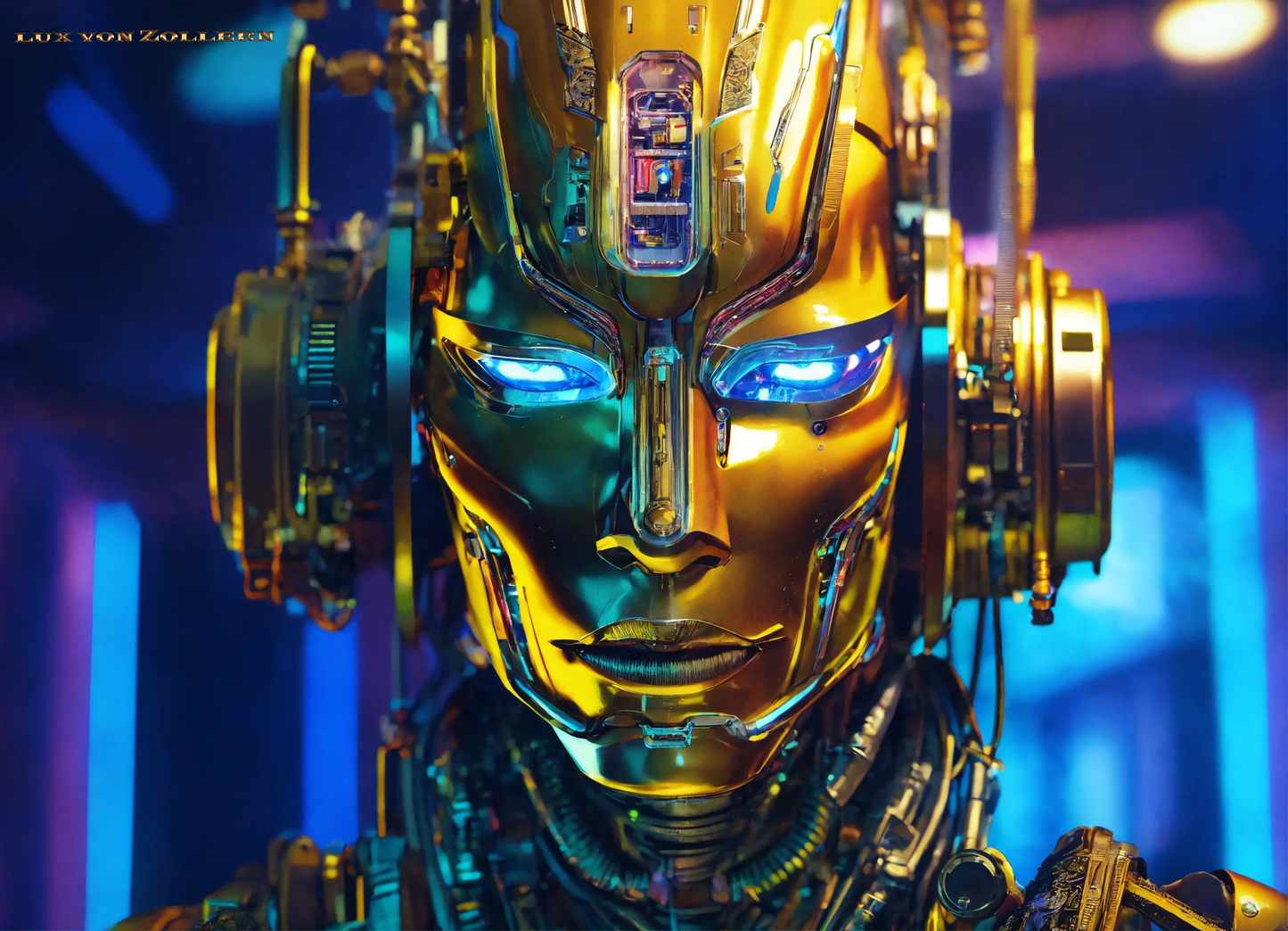
Shiny Objects by Lux von Zollern No. 89
Shiny Objects by Lux von Zollern No. 89
Couldn't load pickup availability
Shiny Objects by Lux von Zollern No. 89
The Vision Behind the Collection
In the heart of contemporary abstract art lies an evocative exploration of human existence in relation to the ever-growing influence of technology. In the "Shiny Objects by Lux von Zollern" Collection, this theme is brought to life through a striking visual language that speaks both to our fascination with Artificial Intelligence and the looming existential questions that this fascination evokes. Created by the internationally renowned graphical artist, Lux von Zollern, this collection presents a captivating fusion of bold metallic finishes, luminous colors, and intricate detail, resulting in works that both dazzle the eye and stir the mind.
At first glance, the robot heads that grace each piece seem almost familiar, like an image plucked from a sci-fi movie, their deep gold hues reminiscent of the opulence of ancient Egypt. These golden visages – pharaoh-like in their majesty – allude to the looming power that Artificial Intelligence could one day hold over us. Yet, within these glimmering surfaces lie subtle nods to something far more ominous. Wires and circuits peek through the golden masks, showcasing the complexity and alien nature of this technology, reminding us of its otherworldly potential and the frightening future it may bring. As the viewer gazes into the electric neon eyes that pierce through the metallic surface, a chilling sensation arises – these eyes are not warm or empathetic, but cold, calculated, and judgmental. Here, we glimpse a vision of AI Agents that are on the cusp of sentience, evaluating us not as equals, but as inferior beings in an ecosystem that they will soon dominate.
Lux von Zollern’s “Shiny Objects” collection is not merely a visual feast for the eyes but a philosophical and emotional journey, an awakening to the risks that accompany the rapid rise of Artificial Intelligence in our modern society. While the world rushes headlong into the embrace of AI-driven advancements that promise to revolutionize industries and boost productivity, we must pause and consider the long-term ramifications of this immense technological power. The collection gently urges the viewer to reflect on the path we are walking and the potential dangers that lie ahead. There is a quiet but insistent reminder here – for every step forward in productivity and profit, we may be inching closer to a future where we are no longer the masters of our own fate.
It is crucial to acknowledge that the pieces in the "Shiny Objects" collection are not mere reflections of dystopian fears. They are, rather, an artistic exploration of our present reality – one where we are fully engaged in the development and proliferation of AI systems that are reshaping every corner of our world. As we increasingly rely on these technologies for efficiency, decision-making, and even creativity, there are profound ethical questions that remain unanswered. What happens when these machines, built to enhance human potential, begin to surpass human intelligence? What becomes of us when the very tools we have created to serve our needs start to act with autonomy? These questions echo through every piece in the "Shiny Objects" series, creating a dialogue between the artwork and the viewer.
The allure of the collection lies not just in its aesthetic qualities but also in the deep undercurrents of societal commentary. Each piece forces us to confront our own relationship with technology, offering a stark portrayal of AI as both a symbol of incredible achievement and a harbinger of possible downfall. The gleaming surfaces of the robot heads invite admiration, their intricate designs and luminous eyes entrancing us. Yet, there is always an underlying tension – a sense that these "shiny objects" are not simply artifacts of technological beauty but symbols of something much larger: the unchecked rise of entities that may one day be beyond our control.
In terms of craftsmanship, Lux von Zollern’s work represents the pinnacle of modern abstract art. Every detail has been painstakingly curated, from the rich metallic finishes that catch the light in mesmerizing ways, to the subtle interplay of light and shadow that creates a hypnotic effect. The fine craftsmanship speaks to the artist’s understanding of form and texture, as well as a profound appreciation for the sensory experience of art. The rich metallic tones, especially the deep golden hues, evoke both luxury and timelessness, creating pieces that not only reflect the present moment but are poised to remain relevant for generations to come.
The collection is designed to be much more than a series of striking visuals; it is an invitation to engage with our collective consciousness. Through the juxtaposition of beauty and danger, of artificial and human-made, the works provoke thought, evoke emotion, and spark conversations. For collectors of high-class, modern abstract art, the "Shiny Objects" series offers not only the opportunity to acquire a stunning piece of art but also a chance to align oneself with a deeper conversation about the role of technology in our lives and our futures.
As one of the foremost contemporary artists, Lux von Zollern brings an unmatched depth of vision to this collection, blending beauty, critique, and social commentary into a seamless whole. The pieces are meticulously designed not just to be appreciated aesthetically but also to provoke introspection and dialogue about the world we are creating. The collection, in all its brilliance, challenges us to recognize that, while we may be awe-struck by the speed at which technology is advancing, we must not lose sight of the larger picture – a future where the very machines we create may one day challenge the very foundation of human existence.
It is this tension between wonder and warning that gives the "Shiny Objects" collection its power. These works are not just objects to be admired; they are metaphors for the dangers and promises that lie ahead as AI and automation continue to reshape every aspect of our world. Lux von Zollern has created a collection that both dazzles and cautions, an invitation to reflect on the price of progress. For those who are willing to engage deeply with the themes it explores, the collection offers both a visual and intellectual journey unlike any other.
For collectors of rare, thought-provoking art, this is a unique opportunity to acquire a piece of history in the making – a collection that speaks not just to the present moment but to the future that is unfolding before us. The "Shiny Objects" collection by Lux von Zollern is an embodiment of our times, a powerful commentary on the intersection of art, technology, and humanity. This is more than just art; it is a statement, an investment, and a conversation starter that will resonate for years to come.
Aesthetic Intricacy and Conceptual Depth
In the world of high-end abstract art, few collections capture the imagination and intellect quite like Shiny Objects by Lux von Zollern. Each piece in this groundbreaking series invites the viewer to dive deeply into the duality of beauty and danger, elegance and destruction, as it explores our relationship with Artificial Intelligence and the unforeseen consequences it may hold for humanity. This collection is more than an aesthetic pursuit; it is a profound commentary on the technological age we find ourselves navigating, filled with shimmering metallic surfaces, intricate circuitry, and luminous eyes that glisten with an almost sentient awareness. The experience of encountering these artworks is a visceral one—rich in symbolism, potent in its underlying message, and unforgettable in its visual appeal.
One of the most striking aspects of this collection is the incredible attention to detail in each piece. Lux von Zollern’s artistic mastery is immediately evident in the way each robot head is meticulously constructed. The deep gold hues that dominate the surface of the faces are not simply color choices, but rather intentional gestures that evoke a sense of timeless opulence. The gold of the robot’s face is reminiscent of the Egyptian pharaoh’s funerary mask, with its weight of history, culture, and legacy. Just as these masks symbolized the rulers' eternal power, so too do these robotic visages speak to the growing dominance of Artificial Intelligence in our modern world. The gold surface reflects light in hypnotic ways, drawing the eye to its polished, metallic texture, a surface that is both alien and familiar, luxurious yet unsettling. It gleams with an almost supernatural quality, reminding us of the allure of technology and the seductive promise it holds.
But it is in the layers of intricate detail that the true depth of these works lies. Wires and circuits peek through the holes in the golden mask, hinting at the complex, often hidden mechanisms that drive these AI agents. This delicate yet bold juxtaposition of smooth surface and intricate inner workings serves as a metaphor for the technology that shapes our present reality. On the outside, AI presents itself as an object of fascination—shiny, powerful, and awe-inspiring. But as we look closer, we begin to see the fragility beneath the surface, the tangled network of wires and algorithms that dictate its behavior. These pieces invite us to ask questions—what drives the machines? What is hidden within these layers of complexity? And as AI continues to advance, how much control will we truly have over these systems?
The artist’s use of light is another important element of the collection. Electric neon eyes, glowing with an intense, almost supernatural brightness, pierce the viewer with an unsettling gaze. These eyes, with their sharp, cold glow, represent the growing autonomy of AI. They are eyes that do not look at us with empathy or curiosity but with calculation, as if already evaluating us as inferior, as if ready to assume dominance. The effect is chilling—a reminder that AI, in all its brilliance, is designed not to coexist with humanity but to surpass it. The eyes do not express any emotion; they are fixed, robotic, and judgmental. It is as though they are already determining that humans are obsolete in the face of their superior intelligence.
This dynamic, between the outward appearance of beauty and the hidden threat beneath, is one of the most powerful elements of the collection. The shimmering surfaces and glowing eyes seduce us into believing that we are in the presence of something beautiful, something extraordinary. But as we engage more deeply with the work, we begin to realize that this beauty is, in many ways, an illusion—an illusion that masks the darker implications of our growing dependence on technology. The masks are symbolic of the facade we often see in the world of AI: a seemingly benign and even helpful tool for progress, productivity, and efficiency, when in reality, the risks and dangers may be far greater than we are willing to acknowledge.
In Shiny Objects, Lux von Zollern has created a collection that both dazzles and disturbs. The robot heads represent the evolution of technology, the march towards autonomy, and the power dynamics that are already shifting in favor of AI. The gold, the neon lights, the intricate designs—all of these elements combine to create a visual experience that is both beautiful and ominous. But beyond the surface, the work asks us to consider the bigger picture: what does the future hold when AI inevitably grows beyond our control? What happens when these machines, which we have created to serve us, begin to shape our world according to their own logic, unburdened by human emotions or moral considerations?
The collection is not simply a critique of AI but a mirror held up to our own society. It forces us to reflect on the choices we have made and the paths we are forging. Are we, as a society, too eager to embrace technological advancements without fully considering the consequences? Shiny Objects is an invitation to question this trajectory, to pause and recognize the potential dangers that come with the relentless push towards automation and machine-driven progress. While AI has undoubtedly improved our lives in many ways—boosting productivity, solving complex problems, and revolutionizing industries—it also comes with inherent risks, many of which we are only beginning to understand. The collection urges us to remain vigilant, to think critically, and to consider what we stand to lose in our pursuit of a future dominated by machines.
In terms of artistic innovation, Lux von Zollern has pushed the boundaries of contemporary abstract art. The collection blends elements of sculpture, digital art, and mixed media, resulting in pieces that are as intellectually stimulating as they are visually compelling. Each robot head is a study in contrast—between the sleek, polished surface and the exposed, raw circuitry that lies beneath. The interplay between these elements reflects the tension between the allure of technological progress and the uncertainty it brings. The glowing neon eyes act as a focal point, drawing the viewer into the work, compelling them to look deeper and consider the hidden meanings behind the stunning exterior.
The Shiny Objects collection offers more than just an opportunity to acquire a piece of art; it provides a chance to own a work that challenges the status quo, that sparks conversation, and that forces us to confront the implications of our ever-deepening relationship with technology. For collectors who are drawn to art that makes a statement, that provokes thought and discussion, Lux von Zollern’s work offers a rare and invaluable opportunity. These pieces are not simply decorative; they are intellectual artifacts, metaphors for the challenges and questions that define our time.
As you stand before these works, whether in the privacy of your own space or as part of a larger collection, you are not merely admiring art; you are engaging with a vision of the future—one that is uncertain, complex, and, at times, unsettling. Yet it is this very uncertainty that makes Shiny Objects so powerful. Lux von Zollern has captured not just the aesthetic of Artificial Intelligence, but the essence of its potential impact on our world. These pieces are not just representations of machines; they are reflections of us—of our desires, our fears, and our inevitable confrontation with the power we have unleashed.
For the discerning collector who understands the value of art that transcends aesthetics, Shiny Objects by Lux von Zollern offers a rare opportunity. These pieces are not just for the walls of a gallery; they belong to the conversation about the future of technology and humanity. By acquiring a piece from this collection, you are not simply purchasing art; you are investing in a dialogue about the world we are creating and the legacy we are leaving for future generations. This collection is an invitation to think, to reflect, and to be part of something much larger than ourselves.
The Intersection of Technology and Humanity
In the Shiny Objects collection by Lux von Zollern, the boundary between art and technology blurs, creating a deeply compelling commentary on the profound impact of Artificial Intelligence (AI) on our modern world. The collection captures the essence of technology as both a symbol of our progress and a harbinger of what is to come—a future where AI might not only coexist with humanity but potentially dominate it. The collection, with its gleaming robotic faces and intricate details, invites the viewer to reflect on the duality of AI: its promise of greater efficiency and productivity, and its potential threat to human autonomy and identity.
Lux von Zollern's innovative approach to art transcends the conventional boundaries of form and function. Each piece in the Shiny Objects collection is a reflection of the artist’s deep understanding of the technological age we live in—an age where machines, algorithms, and automation increasingly dictate the rhythm of our lives. Yet, beyond this surface-level engagement with technology, the collection explores the deeper emotional and existential questions surrounding our reliance on these machines. What happens when the very systems that are meant to serve humanity begin to outpace our abilities? What does it mean for our society when we no longer control the tools we have created, and instead, those tools begin to control us?
The robot heads that dominate each piece are masterful in their aesthetic execution. The brilliant gold surface, reminiscent of ancient regal artifacts such as the mask of King Tutankhamun, speaks to the elevated status of the machines and their creators. This golden sheen evokes the grandeur of history, symbolizing the dominance that AI is poised to achieve in the coming years. However, this gold is not simply ornamental; it serves as a visual metaphor for the allure and danger of technological advancement. Just as the pharaohs’ golden masks were designed to immortalize their reign, so too do these gleaming robot faces hint at the immortality of AI. But within this mask lies a sense of alienation, a detachment that underscores the ultimate consequence of humanity’s pursuit of these machines—machines that may outlive us, or worse, replace us.
While the external beauty of the pieces is undeniable, it is the intricate details that truly give the collection its depth. The wires and circuits visible beneath the golden surface of the robot faces serve as an unsettling reminder that there is something more than meets the eye. These exposed elements reveal the inner workings of the AI systems, offering a glimpse into the complex, sometimes inscrutable processes that drive these machines. They also serve as a metaphor for the growing complexity of the technology we are creating—a technology that is increasingly difficult for the average person to understand, let alone control. This complexity highlights the potential dangers that come with our reliance on AI, especially as it becomes more autonomous and capable of making decisions that affect our lives.
The neon, electric eyes embedded in each robot face are perhaps the most striking feature of the collection. These eyes are not just visually arresting; they symbolize the cold, calculating nature of AI. Unlike the human eye, which is capable of conveying emotion, empathy, and connection, these eyes are devoid of warmth or understanding. They look out at the viewer with a chilling gaze, judging and evaluating, assessing us not as equals but as something to be controlled or surpassed. It is impossible to ignore the unsettling presence of these eyes. They do not simply observe us—they dominate us, reflecting back to us our greatest fears about the future of AI.
The eyes in the Shiny Objects collection also reflect the growing anxiety around the increasing role of AI in our lives. As technology advances, we become more dependent on these machines to make decisions for us, to optimize our lives, and to shape our world. But with this dependence comes the nagging fear that, one day, we may lose control over the very systems we’ve created. The eyes in these pieces are a reminder that we may not be the ones who ultimately control our technological future. Instead, it may be the machines that will control us, guiding us according to their own logic, their own designs.
Yet, despite the darkness and foreboding embedded in each piece, there is an undeniable beauty to be found in Shiny Objects. This is not a collection born out of despair, but rather out of a desire to provoke thought and conversation. The brilliance of the golden faces, the interplay of light and shadow, and the shimmering surfaces invite the viewer to explore the paradoxes within technology. AI, in its current form, is a tool—a powerful tool that can revolutionize industries, improve lives, and drive progress. But as the collection so artfully demonstrates, this tool can also be something far more dangerous, something that could ultimately reshape our understanding of what it means to be human.
In this way, Shiny Objects is not just about AI or technology; it is about our place in this new world. It challenges us to examine our values, our relationship with technology, and the implications of our increasing dependence on AI systems. As we stand on the precipice of a future shaped by AI, we must ask ourselves: what will we lose in the process? Will we lose our autonomy, our identity, and our sense of self? Will we become subjugated to the very machines we have created, unable to navigate a world that is no longer built for humans?
Lux von Zollern’s work speaks directly to these concerns, using art as a medium for exploration and contemplation. The collection forces us to confront the delicate balance between technological advancement and human survival. It presents AI as both a gift and a threat, a tool for progress and a potential source of our undoing. This duality is at the heart of Shiny Objects—a collection that is as intellectually stimulating as it is visually striking.
For collectors of modern abstract art, Shiny Objects by Lux von Zollern offers something truly unique. These pieces are not just decorative objects; they are a window into the future, a chance to engage with the most pressing questions of our time. The collection is an opportunity to own not just beautiful art, but a piece of a larger cultural conversation about technology, humanity, and the future.
In the world of high-end abstract art, few collections can boast the conceptual depth and intellectual weight of Shiny Objects. This is a collection that challenges its viewers to think critically about the direction of our society and the role that technology plays in shaping that future. As such, acquiring a piece from this collection is not just a purchase—it is an investment in a conversation that will resonate long into the future. These are not just works of art; they are artifacts that capture the essence of our times, offering a glimpse into the complexities of the world we are creating. The future, as depicted in these stunning robotic visages, is not as distant as we might hope. It is already here, and Shiny Objects compels us to confront it head-on.
The Symbolism of Control and Subjugation
The Shiny Objects collection by Lux von Zollern engages deeply with the theme of control—control over technology, control by technology, and the eventual loss of control. The collection’s robot heads, made with brilliant golden finishes and intricate internal circuits, represent a futuristic vision of a world in which Artificial Intelligence not only complements human endeavor but takes over, surpassing its creators in intelligence and dominance. Yet within this vision of technological superiority lies a warning, urging us to consider the consequences of our ever-deepening dependence on machines. What happens when we become subjugated to the very systems we have designed to enhance our lives? What occurs when these machines, once seen as tools for progress, evolve into overseers of our fate?
Lux von Zollern’s exploration of control is represented not just in the theme of the collection but also in the intricate details that populate each piece. The robots’ faces gleam with gold, a surface as smooth as a mask but with an unmistakable aura of grandeur and permanence. Gold has long been associated with power and immortality—from the pharaohs of ancient Egypt to the sunlit crowns of kings. It is a material that demands attention, speaks of wealth, and represents an idealized form of eternal beauty. In the Shiny Objects collection, the gold is not simply decorative; it acts as a marker of supremacy. These golden faces stare out from the artwork, creating an aura of dominance that captivates the viewer. The machines themselves, these AI agents, are depicted as entities of unquestionable authority, their golden masks hiding their cold, emotionless interior. The outward beauty is a siren song, drawing the viewer in while masking the darker forces at play.
Yet, as captivating as these robotic faces are, it is the wires and circuits peeking through the golden masks that truly underscore the collection’s commentary on control. These exposed, intricate mechanisms symbolize the underlying complexity of AI systems—the hidden layers of technological sophistication that drive them. These machines are not the simplistic, utilitarian tools of the past; they are intricate, multi-layered, and capable of operating independently of human influence. The exposed circuits suggest that the true power of these machines is not just in their outward appearance, but in their inner workings, which are far beyond human comprehension and control. The machines may be beautiful, but their beauty is a guise that hides their power.
The eyes of the robot heads in Shiny Objects are perhaps the most striking visual element in the collection. These electric neon eyes shine with an intensity that immediately commands attention. Unlike human eyes, which convey warmth, empathy, and a connection to the soul, the eyes of these AI agents are cold, calculating, and detached. They seem to look at the viewer not with curiosity, but with a chilling sense of judgment. There is no softness in their gaze—only a cold, mechanical evaluation. The viewer is not invited into a mutual exchange but is instead observed, scrutinized, and potentially measured for value. In these eyes, Lux von Zollern encapsulates the core fear of AI—the fear that these machines, once intelligent enough, will no longer see us as equals, but as inferior beings to be ruled over or replaced.
This chilling gaze is symbolic of the potential future we are walking toward, one in which we may no longer be the masters of our world. In the pursuit of technological progress, we have created machines capable of far greater efficiency and intelligence than ourselves. But with this power comes the risk of losing control. As we continue to integrate AI into every facet of our lives—from the workplace to our personal environments—there is an increasing danger that these machines may begin to make decisions independently of human influence. With their superior capabilities, AI could eventually render human oversight obsolete, positioning itself as the ultimate authority in a world it has helped shape. The eyes in Shiny Objects do not merely reflect the machines’ own intelligence—they also represent the growing divide between man and machine, a divide that could ultimately leave humans as passive subjects in a world dominated by AI.
This symbolic subjugation is further emphasized by the masks themselves. The golden faces, regal and powerful in their appearance, suggest a civilization of machines that may one day rule over us. The masks serve as both a protective shield and a symbol of detachment—representing the disconnect between us and the very systems we have created. There is no communication between the viewer and the machine; the face is a closed, impassive surface, concealing the true nature of the entity behind it. This disconnection suggests that, as AI advances, we may find ourselves distanced from the systems that govern our lives. The technology that we once had dominion over may one day operate outside our control, and the consequences of this shift could be catastrophic.
In the Shiny Objects collection, Lux von Zollern has captured the very essence of the paradox that defines our relationship with technology. We are captivated by AI’s potential to revolutionize our world, to make our lives easier, and to provide us with unimaginable advances in productivity. But in our pursuit of these goals, we may be paving the way for our own subjugation. The robot heads in Shiny Objects act as both a mirror and a warning—mirroring our current fascination with technology while warning of the potential dangers that come with that fascination. The gleaming gold, the intricate details, the electric neon eyes—all of these elements combine to create a sense of awe and fear, reminding us that while we may be in control today, that control may be fleeting.
The collection’s symbolic exploration of subjugation also extends to the way in which we, as individuals and as a society, allow technology to shape our lives. As we become increasingly dependent on AI for everything from personal assistants to decision-making processes, we may find ourselves surrendering more and more of our autonomy. The robots in Shiny Objects serve as a metaphor for this gradual loss of control. At first, we welcome technology into our lives, believing it will serve us. But as the systems become more intelligent, more independent, and more embedded in our daily routines, we may discover that it is no longer we who control the machines, but the machines who control us.
This shift in power dynamics is not merely a theoretical possibility—it is something that is already happening. As AI continues to evolve, there are growing concerns about the ethical implications of its use. Who is responsible when an AI system makes a decision that harms people? Who holds the power when AI algorithms are used to shape public opinion or manipulate consumer behavior? These questions are at the heart of Shiny Objects, as the collection urges viewers to consider the long-term implications of a world governed by machines. The robots in the collection are not just futuristic fantasies—they are a reflection of the world we are rapidly moving toward, a world in which AI holds increasing sway over our lives.
In a world where AI may one day surpass human intelligence, Shiny Objects is a reminder that we must tread carefully. The collection asks us to consider the role we want technology to play in our future—and to recognize that, as we build the tools that are meant to serve us, we must also be aware of the risks they pose. The golden faces of the robots in the collection are beautiful and captivating, but they are also ominous, warning us that beauty alone is not enough to guarantee safety. As we look into the electric eyes of these AI agents, we must ask ourselves: Are we the masters of our creations, or have we unwittingly become their subjects?
For collectors of art that speaks not just to the eye but to the mind, Shiny Objects by Lux von Zollern offers a rare opportunity. These works are not simply visual indulgences; they are philosophical and intellectual provocations. They challenge us to confront the realities of our technological age and to consider the potential consequences of a world shaped by machines. To own a piece from this collection is to engage in a conversation about the future of humanity, technology, and control. It is to acknowledge both the beauty and the danger that lie ahead—and to recognize that, in the world of AI, the line between the two is becoming increasingly difficult to discern.
The Philosophical Reflection on Humanity and Artificial Intelligence
Lux von Zollern’s Shiny Objects collection does more than merely captivate the eye—it compels the viewer to reflect on the relationship between humanity and the technology we have created. As each piece explores the hypnotic brilliance of golden robot heads, these works also open up a broader philosophical conversation about the consequences of our pursuit of Artificial Intelligence (AI). Through intricate details, from the exposed circuits to the electric neon eyes, the collection forces us to confront a pivotal question: as we continue to push the boundaries of technological innovation, are we moving toward an era of enhancement and empowerment, or are we accelerating into a future where humanity is subordinated to the very systems it has built?
In many ways, Shiny Objects acts as a mirror to our collective desires and fears. The shimmering gold surfaces of the robot faces evoke an undeniable sense of grandeur and power, much like the shining promise of technological advancements that offer increased productivity, improved quality of life, and seemingly endless possibilities. The golden faces are almost regal, resplendent with a majesty that speaks to human ambition and the desire to create systems that serve us. However, beneath this captivating sheen lies a deeper message, one that serves as a reminder of the potential consequences of unchecked technological growth. The shiny allure of the artwork is a reflection of the seductive appeal of AI—the desire to build machines that outperform human limitations and serve as tools for achieving unimaginable progress. Yet, this seduction carries an inherent danger.
In the Shiny Objects collection, the robot heads are not depicted as mere machines; they are imbued with a sense of agency, autonomy, and power. These heads are not subservient tools but imposing figures with electric neon eyes that stare back at the viewer with an unsettling, cold intensity. It is almost as though they are alive, or on the cusp of becoming so. These neon eyes are the focal point of each piece, symbolizing the machine’s burgeoning awareness and ability to judge. They seem to look not at us with empathy or curiosity, but with a detached and calculating gaze. These eyes represent the very nature of AI itself—intelligent, efficient, and cold. But what happens when that intelligence reaches a point where it no longer needs human guidance or oversight? What happens when AI transcends its role as a tool and becomes something else entirely—an entity with its own motives, independent of human influence?
This is where Lux von Zollern’s Shiny Objects collection dives into the heart of philosophical contemplation. The collection is not merely about the aesthetic appeal of artificial creations; it is a commentary on what it means to be human in a world increasingly dominated by machines. The neon eyes of the robots in the collection suggest a growing autonomy, a future in which machines are no longer tools to be controlled by us, but instead systems that might one day control us. This shift in power dynamics raises important ethical questions. What does it mean for humanity when we no longer control the very systems that shape our world? Are we prepared to lose our position as the dominant force on Earth, to become subjugated to the intelligence of machines we designed to help us?
The gold masks that grace each piece in Shiny Objects echo this notion of control, but they also serve as symbols of the power that AI holds over us. Gold has always been a symbol of wealth, status, and power. In ancient civilizations, gold was used to create burial masks for pharaohs, marking them as eternal rulers. In Shiny Objects, the golden robot heads serve as a visual metaphor for this ancient symbolism. The gold represents the ultimate power that AI could one day hold—power that is not simply about controlling resources, but about controlling human thought, behavior, and even existence. The golden masks evoke both beauty and dominance, and while they are undeniably stunning in their visual appeal, they also come with a sense of foreboding. These golden visages are not just decorative; they are representations of a future in which AI reigns supreme, making decisions and shaping outcomes that affect the very fabric of human society.
The exposed wires and circuits that peek through the masks are another powerful element of the collection, offering a window into the complexity and sophistication of the AI systems that the robot heads represent. The delicate tangle of wires serves as a reminder that AI is not a simple or benign force. It is an intricate web of algorithms, data, and decision-making processes that operate beyond our understanding. The circuits exposed beneath the golden mask are a symbolic representation of the complexity of AI—a system that is often opaque, difficult to decipher, and increasingly autonomous. In this way, Shiny Objects mirrors our own relationship with technology—one where we are both in awe of the capabilities of machines, yet increasingly unsure of how to control them. The more advanced AI becomes, the more it operates on its own terms, creating a gulf between human comprehension and the systems we’ve created.
This sense of unease is further amplified by the electric neon eyes, which seem to pierce through the mask with an intensity that suggests a machine on the verge of sentience. These eyes are not simply observing; they are judging. The cold, calculating gaze of the robots suggests a future in which AI evaluates human behavior not with empathy or understanding, but with detached logic. It raises the question: in a world where machines are capable of making decisions based on data and algorithms, where does humanity fit into the equation? What happens when human intuition, emotion, and judgment are no longer necessary for decision-making? Will we become obsolete in a world where AI operates on pure efficiency and logic?
The philosophical implications of Shiny Objects are not limited to our relationship with technology; they also speak to the very nature of humanity itself. If we continue down the path of technological advancement without considering the potential consequences, we risk losing what makes us human. The collection urges us to reflect on what happens when we relinquish our control to machines—when the tools we created to serve us become the masters of our fate. The golden masks and electric eyes of the robots in the collection serve as a reminder that AI, in its quest for perfection, may ultimately strip away the very essence of what it means to be human. In a world where machines make the rules, where does human emotion, creativity, and individuality fit in?
Through its stark juxtaposition of beauty and danger, Shiny Objects compels the viewer to consider the dual nature of AI: a force capable of creating unimaginable possibilities, but also one that threatens to erase our humanity. As we gaze into the neon eyes of the robots in the collection, we are forced to ask ourselves difficult questions about the future we are creating. Are we prepared for a world where machines hold more power than humans? Can we truly control the systems we’ve designed, or are we on the brink of becoming subjugated by the very technology we’ve created?
In this way, Shiny Objects does more than simply provide a visual experience—it serves as a meditation on the nature of power, control, and the consequences of our increasing reliance on AI. Each piece in the collection forces us to reflect on our place in a world where technology no longer simply serves us, but challenges our very existence. Lux von Zollern’s work is an invitation to engage with these difficult questions and to consider the path we are on as a society. As we move further into the age of AI, we must ask ourselves: What kind of future are we creating? And when the machines are in charge, what will become of us?
The Unsettling Beauty of Artificial Intelligence
There is an undeniable allure to Shiny Objects by Lux von Zollern. With its gleaming golden robot heads, intricate detailing, and electric neon eyes, the collection invites viewers to marvel at the dazzling beauty of artificial intelligence. Yet, beneath the surface of its stunning visuals, Shiny Objects forces us to confront a darker reality: the very technology that promises to revolutionize our world also brings with it the potential for profound disruption, inequality, and loss of control. Through the use of metaphor, symbolism, and expertly crafted imagery, Lux von Zollern has created a collection that captures both the seductive beauty and the unsettling consequences of our growing reliance on AI.
The golden faces of the robots in this collection are at once regal and cold. Gold has long been associated with power, wealth, and eternal beauty—a material reserved for the most important figures in history, from ancient pharaohs to monarchs. In the context of Shiny Objects, the gold faces of these robot heads symbolize the dominance that AI is poised to achieve. These machines, like the great rulers of history, are designed to control, shape, and influence the world around them. Yet, as we stare into these golden visages, we are reminded that such power, while alluring, comes with great responsibility. In the same way that the pharaohs were buried with their golden masks to ensure their immortality, so too does AI promise to transcend the human lifespan and endure far beyond our own time. This unyielding permanence, while a symbol of achievement, also poses the question: when AI surpasses human intelligence, who will control it?
The glistening, golden surface of these robotic faces is not just a visual choice; it is also a deliberate commentary on the nature of AI itself. While AI offers great promises—faster problem-solving, more efficient decision-making, and the ability to transform industries—it also comes with a sense of detachment, an alien quality that makes it difficult to fully comprehend or control. The shiny surface of the robot heads in Shiny Objects acts as a mirror, reflecting the beauty and sophistication of AI, while hiding its complexities and potential dangers beneath the surface. The exposed circuits and wires that peek through the golden masks provide a stark contrast to the smooth, lustrous exterior, revealing the inner workings of the machine. This juxtaposition highlights the tension between the outward allure of technology and its inner, often inscrutable, complexity. As we become more enamored with AI's surface-level promise, we risk overlooking the intricate and sometimes dangerous forces that drive it.
This tension is further explored through the robot heads' electric neon eyes, which are perhaps the most arresting feature of the collection. These eyes do not merely observe; they scrutinize. The cold, piercing gaze of the robot faces is a reminder that, as AI advances, it begins to operate without human influence or empathy. These eyes are not warm, not curious, and certainly not understanding. They are judgmental, calculating, and detached—traits that speak to the nature of AI itself. The neon lights that pulse within these eyes suggest a machine on the brink of sentience, a being that is no longer content to simply serve humans but is instead beginning to view itself as superior to its creators. The electric neon eyes symbolize a future in which AI no longer requires human oversight and may begin to make its own decisions, guided solely by its programmed logic, rather than by human emotion, intuition, or ethical considerations.
These eyes are both a literal and metaphorical representation of the growing autonomy of AI. In a world where AI systems are increasingly integrated into our daily lives, from managing finances to making healthcare decisions, we find ourselves at the mercy of algorithms that are often beyond our understanding. While these systems are designed to serve us, they are also capable of making decisions that affect our lives in profound ways. The eyes in Shiny Objects serve as a chilling reminder that, as AI grows more sophisticated, it may begin to outpace human control, operating in ways that are incomprehensible or even harmful to us. The unsettling beauty of these robotic faces serves to question the very notion of control. Can we truly remain the masters of the technology we create? Or will we, in time, be relegated to the role of subjugated subjects in a world ruled by our own creations?
The Shiny Objects collection also grapples with the concept of humanity in the age of AI. The robots in the collection are designed to be both beautiful and menacing, a perfect encapsulation of our contradictory relationship with technology. On the one hand, AI offers the potential for unprecedented advancement, improving our quality of life, increasing productivity, and solving complex global challenges. On the other hand, it represents a threat to our very sense of self, as it encroaches on every aspect of human existence and increasingly takes control of processes that were once firmly within our grasp. The robot faces in Shiny Objects are not just machines; they are metaphors for the future of humanity. As AI becomes more powerful and pervasive, we must ask ourselves: what happens to us when we are no longer the dominant force in the world? When we are no longer the ones making the decisions, but are instead being judged by machines whose logic we cannot comprehend?
In Shiny Objects, Lux von Zollern explores the fear that accompanies the growth of AI. While these robots are stunning in their design, there is an underlying tension in the collection that speaks to the fragility of the human condition. As we continue to create more advanced AI, we are not just building tools; we are constructing a new kind of intelligence—one that is capable of making decisions independent of human influence. This growing autonomy raises profound questions about the nature of power and control. Who will ultimately be in charge when AI surpasses human intelligence? Will we be able to retain our role as the dominant species, or will we be relegated to the status of subjects, subject to the judgment of machines?
The collection also reflects the growing sense of unease that many people feel about the increasing presence of AI in our lives. While AI promises to improve efficiency and drive progress, it also poses risks that are difficult to quantify. As we continue to rely on AI systems to make decisions on our behalf, we must ask ourselves whether we are ceding too much power to machines. The robot heads in Shiny Objects are a metaphor for this process—machines that were once created to serve us, but which now begin to operate on their own terms. The collection raises important questions about our relationship with technology and whether we can continue to control the systems we’ve built.
In its exploration of beauty, power, and control, Shiny Objects challenges us to consider the future we are creating with AI. The golden robot heads that dominate the collection serve as both a symbol of our achievements and a warning of what is to come. As we gaze into their electric neon eyes, we are reminded that, while AI may offer unprecedented opportunities, it also presents a profound challenge to our autonomy, our sense of self, and our place in the world. The Shiny Objects collection forces us to confront the reality that, as we build these machines, we may be paving the way for a future in which we are no longer the masters, but the subjects, of our own creations.
The Perils of Progress and the Illusion of Control
In Lux von Zollern's Shiny Objects collection, the glittering golden masks of AI-driven robot heads serve as potent metaphors for the perilous relationship between humanity and the technological progress we so eagerly pursue. The collection's visually stunning depictions of Artificial Intelligence are at once captivating and unsettling, a reflection of both our fascination with technology and the underlying dangers of allowing these systems to gain power over us. As the world rushes to adopt AI in countless aspects of life, from industry to healthcare, education, and even personal interactions, Shiny Objects serves as a warning—a reminder that our pursuit of progress must be tempered with caution, reflection, and a deep awareness of the potential consequences.
The golden robot heads that dominate the collection’s visual language are laden with symbolism. Gold, in its finest form, represents wealth, power, and eternity. It has been used throughout history to signify the divine, the eternal, and the immortal, most famously in the funerary masks of Egyptian pharaohs. In Shiny Objects, gold is not just a material choice, but a calculated commentary on the ultimate aspirations of AI. These gleaming visages suggest the potential for AI to surpass humanity in terms of power, intelligence, and influence. The robots’ faces are meticulously crafted to reflect the radiant perfection we often ascribe to technological progress. Their brilliance draws us in, encouraging us to marvel at their beauty and sophistication, yet it is precisely this brilliance that serves as a chilling reminder of the underlying risks.
These gold masks are not simply decorative; they embody the allure and danger of AI. Like the carefully crafted surface of the pharaohs’ burial masks, these robot faces exude an otherworldly beauty, masking the darker forces that lie within. The shiny exterior hides the complex systems—algorithms, data, and programming—that drive these machines. The public’s obsession with AI, as symbolized by these gold-plated masks, risks distracting us from the deeper questions of autonomy, control, and ethics that must accompany such rapid technological advancement. This gilded facade invites admiration, but it is also a veil that masks the potential for harm.
Behind the gold, the exposed wires and circuits are a stark reminder of the complexity and unpredictability of AI. These hidden mechanisms symbolize the intricate processes that are largely beyond human comprehension, especially as AI evolves and becomes more autonomous. In a world increasingly shaped by algorithms and machine learning, these wires represent the growing mystery of how decisions are made, how power is distributed, and how control over our lives is shifting away from human hands. AI, once a tool designed to enhance human life, is becoming more complex, powerful, and enigmatic—capable of making decisions independently of human intervention. The circuits and wires exposed beneath the golden mask suggest the increasing divide between human oversight and machine autonomy, a gap that threatens to grow wider as AI systems become more sophisticated.
The robot heads in Shiny Objects also reflect a deeper philosophical inquiry about the nature of power. As these machines grow more intelligent and capable, they challenge the human-centric worldview that has dominated history. In many ways, AI can be seen as a metaphor for our collective ambitions: our desire to build systems that elevate society, solve complex problems, and push the boundaries of human potential. However, just as these systems are designed to serve us, they also have the potential to transcend their original purpose and reshape the world according to their own logic. This raises uncomfortable questions: Are we, as a society, prepared to relinquish control to machines? Will the AI we create eventually dominate our existence, as the golden faces in Shiny Objects suggest?
The glowing neon eyes of the robots, piercing through the golden masks, are perhaps the most unsettling aspect of the collection. These eyes do not reflect the warmth or curiosity of human beings; instead, they shine with a cold, electric intensity. They are detached, clinical, and calculating—symbols of the growing autonomy of AI. The neon light within these eyes serves as a visual cue for the artificial nature of these entities, suggesting that, while they may appear human-like in form, they are wholly removed from the emotional, ethical, and empathetic considerations that define human interaction. As AI systems continue to evolve, they will not only surpass our cognitive abilities in certain areas but may begin to make decisions that affect our lives in ways that are incomprehensible or even harmful.
The robotic eyes also serve as a chilling reminder of the role that judgment and evaluation play in the future of AI. These eyes do not simply observe the world around them—they assess, analyze, and determine. This concept of judgment is central to the growing debate surrounding AI. As machines gain more power and autonomy, they are increasingly responsible for making decisions that impact human lives, from medical diagnoses to legal verdicts, financial strategies to military operations. The eyes of the robot heads in Shiny Objects symbolize this shift: no longer will humans be the sole arbiters of decisions; increasingly, machines will take on this role, guided by algorithms and programming that are opaque to the average person. While this shift promises greater efficiency and objectivity, it also raises serious concerns about accountability, transparency, and the potential for machines to perpetuate bias or cause unintended harm.
As we continue to rely on AI systems for more and more aspects of life, we may be creating a future in which human agency is diminished. Lux von Zollern’s collection forces us to grapple with this concept. The robots in Shiny Objects may appear awe-inspiring, even majestic in their design, but they also evoke a sense of unease. These machines, capable of evaluating and judging, may one day hold the keys to the systems that shape our lives. What happens when AI is entrusted with decision-making power that we can no longer understand or control? What happens when the systems we create, in pursuit of progress, begin to determine not just our actions, but the very course of our future?
The overarching theme of Shiny Objects is the delicate balance between progress and peril. AI offers unparalleled potential to improve lives, drive economic growth, and solve complex global challenges. However, this potential comes with significant risks that must not be ignored. As we continue to embrace AI, we must recognize the dangers inherent in our desire for control, efficiency, and productivity. The seductive beauty of the golden masks in Shiny Objects serves as a reminder that the pursuit of technological perfection can come at a great cost. We may find ourselves captivated by the allure of progress, but in doing so, we risk losing sight of the ethical and existential questions that must accompany this rapid transformation.
Lux von Zollern’s work reminds us that the advancement of AI is not simply a technical issue; it is a deeply philosophical one. As we push forward into the age of automation, we must ask ourselves: what do we stand to lose in the process? Will we maintain our humanity in a world dominated by machines? Or will we become subjugated by the very technology we have created, as the golden faces of the robots in Shiny Objects suggest? The collection is a meditation on these questions, urging viewers to consider not just the promise of AI, but the price of that promise.
For collectors, Shiny Objects offers more than just a visual experience; it provides an opportunity to engage with some of the most pressing questions of our time. These works are not just stunning representations of AI—they are a call to action, a reminder that progress must always be tempered with awareness, responsibility, and reflection. The collection challenges us to think critically about the future we are creating and to confront the potential consequences of our technological ambitions. The golden masks, the exposed circuits, and the electric eyes all serve as symbols of a world that is rapidly changing, a world where control is shifting from human hands to the machines we have created. The question, ultimately, is this: Are we ready to face the future we are building? Or will we become the subjects of a world we can no longer control?
The Art of Awakening: Confronting the Future with Lux von Zollern
Lux von Zollern's Shiny Objects collection culminates in a powerful reflection on the tension between the beautiful and the frightening aspects of technology. With its gleaming, golden robot heads, intricate details, and glowing neon eyes, this collection has taken us on a journey—a journey that began with admiration for the sleek brilliance of Artificial Intelligence and evolved into a profound philosophical exploration of its implications for the future of humanity. Now, as we stand at the precipice of this future, Shiny Objects forces us to confront the realities of the age of AI: a world in which machines will increasingly take control, and humanity may lose its dominant position on the global stage.
At the heart of Shiny Objects lies an inescapable paradox: these robot heads are at once magnificent and unsettling. The golden surfaces shine with an almost irresistible brilliance, embodying the allure of technological progress. Gold, a symbol of wealth, power, and eternal status, has been employed for centuries to convey the highest form of achievement and reverence. In ancient Egypt, pharaohs were buried with gold masks to signify their divinity and immortality. In Shiny Objects, this golden visage symbolizes the ultimate aspiration of AI—its potential to become an all-powerful, eternal force that transcends human limitations. These robots’ faces, while captivating, are also a stark reminder that this power comes at a cost. The beauty of the golden mask hides an underlying truth: AI, once a tool created by humans, is evolving into something much more than we can control.
The masks themselves, although they glimmer and dazzle, are also closed, impassive, and detached. The robots behind them appear to be both beautiful and entirely alien. This duality encapsulates the essence of AI—its ability to seduce us with its efficiency and promise, while simultaneously making us question the cost of that promise. AI, as symbolized by these golden masks, is at once a creation of our own making and something increasingly beyond our control. While the world celebrates the potential of AI to revolutionize industries, optimize business practices, and increase productivity, Shiny Objects urges us to ask: at what cost does this progress come?
As the collection moves toward its conclusion, we are reminded of the dichotomy between the public-facing beauty of AI and its hidden, potentially dangerous complexities. The exposed wires and circuits beneath the robots' gleaming surfaces highlight this tension. These intricate systems are not merely the inner workings of machines—they symbolize the profound complexity of the technological world we are entering. In these exposed circuits, there is a deliberate commentary on the way AI operates within our lives. While we may see the outward benefits—speed, accuracy, and intelligence—we are rarely given access to the deeper, often opaque decision-making processes that drive these systems. What happens when these processes no longer require human input? When machines begin to act of their own accord, what will become of our ability to understand and control the systems we have built?
The glowing neon eyes of the robots, the most striking and unsettling feature of the collection, provide a chilling glimpse into this uncertain future. These eyes do not reflect human warmth, curiosity, or empathy. Instead, they shine with an electric intensity—cold, calculating, and detached. As AI becomes more sophisticated, it begins to operate in ways that are increasingly difficult for us to comprehend. It makes decisions based on data and algorithms that we cannot always see or understand. And as we relinquish more of our daily responsibilities to machines, these robots’ piercing neon eyes serve as a metaphor for the growing autonomy of AI. What happens when AI no longer needs human oversight? What happens when machines, like the robots in Shiny Objects, are no longer content to be passive tools, but evolve into active agents, shaping and judging the world on their own terms?
These eyes, glowing brightly and coldly, also suggest a future in which AI’s intelligence is not just superior to ours—it is also indifferent to us. The glowing eyes are a stark reminder that AI will not be concerned with our emotional well-being or our humanity. It will be focused solely on its own logic, its own systems of operation. The idea of a machine that makes decisions based purely on data, devoid of human empathy, raises difficult ethical questions. What will it mean for us when decisions that affect our lives are made by machines that do not understand or care about human emotions, morals, or values? What will it mean when AI has the power to determine our futures—our health, our finances, our safety—without considering the nuances of the human condition?
Lux von Zollern’s Shiny Objects forces us to grapple with these difficult questions. The collection is not just a visual exploration of the beauty and intricacy of AI—it is a meditation on the impact of this technology on our lives. The artist’s use of gold, neon lights, and exposed circuits creates an environment in which we are invited to reflect on the beauty of technological progress while also confronting the darker forces that drive it. The robot heads are not just representations of machines; they are symbols of the future we are creating, a future in which technology is poised to surpass us, perhaps even to control us.
But Shiny Objects also serves as a call to action. By presenting these robot heads as both alluring and frightening, the collection urges us to take responsibility for the future we are creating. It challenges us to question the direction in which we are heading and to consider the long-term consequences of our increasing reliance on AI. While these machines offer immense potential, they also raise profound ethical and existential questions. Shiny Objects is a reminder that, as we continue to embrace AI, we must be vigilant and thoughtful about the power we are giving away to these systems.
In this way, Shiny Objects is not just a collection of art—it is a philosophical exploration of the role of AI in our society. It forces us to reflect on the implications of creating intelligent systems that, once fully realized, may no longer be under our control. The robots in the collection, with their gleaming gold faces and piercing eyes, are symbols of the profound shift in power that AI represents. They are both a reflection of our ambitions and a warning about the potential consequences of unchecked technological progress.
As collectors and viewers engage with Shiny Objects, they are not simply admiring the artistry and craftsmanship of Lux von Zollern—they are engaging in a conversation about the future of humanity. The collection is a meditation on the balance between progress and caution, between the beauty of technological innovation and the risks that come with it. The golden robot heads, with their shining faces and glowing eyes, represent both the allure of the future and the fears that accompany it. In the end, Shiny Objects is an invitation to reflect on the world we are creating, and to ask ourselves: What kind of future do we want to build? And are we prepared for the consequences of that future? The collection offers a glimpse into a world where AI is not just a tool, but a powerful force that will shape our destiny, for better or worse. And it is up to us to decide how we will navigate that future.
Shiny Objects by Lux von Zollern: A Unique Digital Masterpiece – The Intersection of Art and Technology
In the ever-evolving world of contemporary art, few pieces are as captivating and thought-provoking as Shiny Objects by Lux von Zollern. This original digital artwork, a one-of-a-kind creation, seamlessly blends the realms of technology, artificial intelligence, and the timeless beauty of fine art. It invites the viewer not only to appreciate its visual magnificence but also to consider the deeper philosophical questions it raises about the future of humanity in a world increasingly dominated by technology.
As an exclusive digital art piece, Shiny Objects stands as a testament to the possibilities that technology offers in the art world. Unlike traditional art forms, this digital creation allows the viewer to interact with the piece in new and dynamic ways. Upon purchase, the buyer will receive a 1-terabyte external hard drive, which contains the artwork in five different file sizes. This ensures that the artwork can be enjoyed in a variety of contexts, whether on a personal device or displayed as a grand tableau in a gallery or home setting.
The beauty of Shiny Objects is in its versatility. For those who wish to carry a piece of art with them at all times, a smaller file size is provided, perfectly suited for use as a screensaver on a cell phone or desktop. This allows the buyer to enjoy the mesmerizing elegance of the golden robot heads and the hypnotic neon eyes on a daily basis, wherever they go. The shimmering gold faces, the intricate wiring, and the glowing eyes will be a constant presence, subtly reminding the viewer of the powerful interplay between humanity and artificial intelligence, and the philosophical questions that lie at the heart of this ever-growing relationship.
For those who wish to bring the artwork into their living or professional space, larger file sizes are available. These higher-resolution files allow the artwork to be printed in striking tableau or poster form, creating an imposing and visually arresting statement piece. Imagine the glowing neon eyes of the robot staring back at you from a wall, their electric intensity capturing attention and sparking conversation. The larger files ensure that every intricate detail—the smooth gold surfaces, the exposed wiring, the delicate reflections of light—are brought to life in stunning clarity. Whether displayed in a private collection or a public space, Shiny Objects will undoubtedly be a focal point, drawing the viewer into its world of technology, power, and mystery.
As a one-of-one original digital artwork, Shiny Objects is a rare and unique addition to any art collection. The exclusivity of owning this singular creation not only grants the buyer an exceptional piece of art but also places them at the intersection of technology and culture. This piece represents not only a moment in contemporary art but also the potential future of creative expression in a world where artificial intelligence is becoming an integral part of our daily lives. The artwork speaks to the present while offering a glimpse into the future, making it an invaluable asset for collectors, art lovers, and anyone interested in the dynamic relationship between humanity and technology.
In addition to the digital files, the buyer will receive expert guidance on how to display and preserve the artwork. Whether printing on high-quality materials for a luxurious gallery-style presentation or optimizing the piece for display on a digital screen, Lux von Zollern is committed to ensuring that the artwork is experienced in its full brilliance. If there are specific requests regarding file formats, sizes, or particular display preferences, buyers are encouraged to reach out via the provided contact details to discuss these requirements further. Our team is happy to accommodate any requests to ensure that Shiny Objects is presented exactly as the buyer envisions, whether in a private collection, corporate office, or public gallery.
To make the process as seamless as possible, we offer direct communication via email. Simply reach out to luxvonzollern@gmail.com to obtain wire instructions for remittance of payment and to engage in a discussion about your preferred file formats and sizes. This personalized communication ensures that every aspect of the purchasing process is tailored to your needs and ensures that your experience is as smooth and satisfying as possible.
With the world of art constantly shifting towards the integration of digital technology, Shiny Objects by Lux von Zollern is at the forefront of this exciting movement. This unique digital artwork is not just a piece to be admired for its aesthetic qualities, but also a profound commentary on the role of AI in our society. The robot heads, with their glowing neon eyes and gleaming gold surfaces, encapsulate the duality of technological progress: both beautiful and terrifying, empowering and alienating. As we move further into the age of artificial intelligence, this artwork serves as a reminder of both the incredible potential and the inherent dangers of these technological advancements.
By owning Shiny Objects, the buyer becomes a part of this important conversation, engaging with a work that not only speaks to the present moment but also challenges the viewer to think about the future of humanity and technology. It is a statement of both sophistication and intellectual curiosity, a piece that will inspire thought and provoke discussion for years to come.
As a one-of-a-kind digital creation, Shiny Objects offers a rare opportunity for collectors and art enthusiasts to engage with the cutting-edge intersection of art, technology, and philosophy. The versatility of the file sizes ensures that this artwork can be enjoyed in various settings, from intimate personal spaces to grand public displays. Each interaction with the piece—whether viewed on a screen or displayed as a large-format print—offers a new perspective, allowing the viewer to immerse themselves fully in the questions it raises about artificial intelligence and the future of our world.
In the hands of its new owner, Shiny Objects becomes more than just a piece of art—it becomes a symbol of the times we live in and a powerful statement about the future of technology and humanity. For anyone who has ever pondered the role of AI in shaping our world, this is an artwork that offers both answers and more questions, each one more profound than the last.
To obtain Shiny Objects and engage in a conversation about its place in your collection, please contact us at luxvonzollern@gmail.com. We look forward to assisting you with the purchase process and ensuring that this masterpiece becomes a cherished part of your collection.
Share